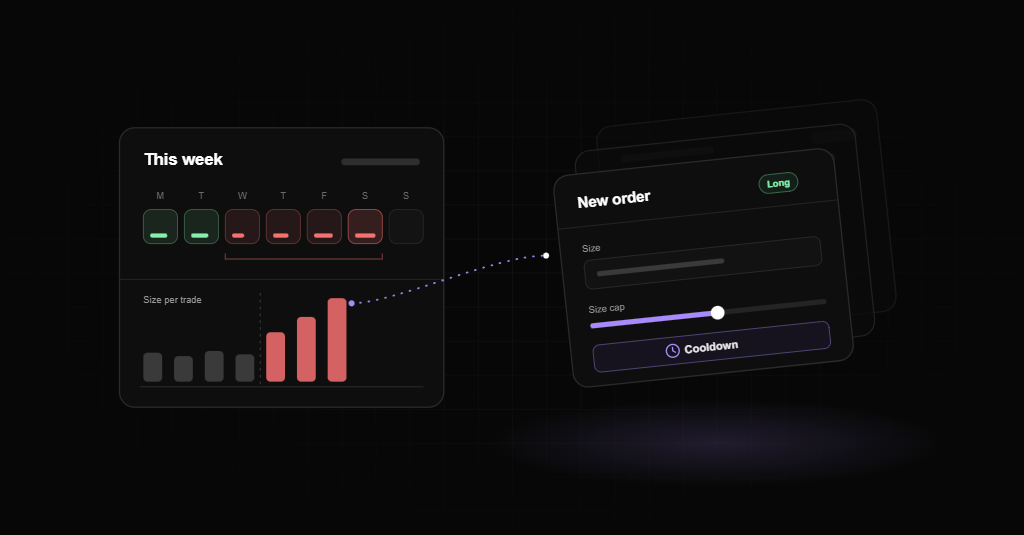
To stop revenge trading, put a rule you wrote before the session between a losing trade and your next order. A fixed cooldown after every loss, a daily loss limit that ends the session, and a size cap that can't go up after a red trade will break most of the loop. Then journal the trades you take soon after a loss as their own group, so you can see what they cost you in plain numbers.
Willpower in the moment rarely holds up. The plan has to be made while you're calm and enforced by something you can't argue with at 2am.
What revenge trading looks like in a crypto account
Revenge trading is any trade you take mainly to win back a loss you just took. The setup is an afterthought. The real goal is getting the day back to green.
In crypto it tends to look like this:
- A new position opened within minutes of a stop being hit, often on the same coin
- Size that jumps after a loss, so one win can "fix" the day
- Leverage creeping up for the same reason
- A switch to a coin you don't normally trade because it's moving fast
- A stop that gets moved or skipped because taking a second loss feels unbearable
- A day with three or four times your usual trade count
None of these is a disaster alone. Together they turn a normal losing trade into a losing day, and a losing day into a damaged account.
Why it keeps happening
A loss feels like money that was taken from you, and the brain treats it like a debt to collect. Each new trade feels like a chance to settle up.
Crypto makes that urge easy to act on. The market never closes, so there is no bell telling you to stop. Perps let you size up in two clicks. And price is always moving somewhere, which hands you a reason to jump back in.
Knowing why you do it doesn't stop you. Traders who understand loss aversion perfectly still revenge trade. What changes behavior is friction: rules that make the next trade slower or impossible for a while.
How to spot it in your own history
Before you add rules, find out how often it happens and how much it costs. Most traders guess wrong in both directions. Some think they do it constantly when it's one bad Friday a month. Others think it's rare and find it in half their red days.
Look for these signals in your trade history:
| Signal | What to look for | Where it usually shows up |
|---|---|---|
| Short gap after a loss | Next trade opened within 15 to 30 minutes of a losing close | Trade timestamps, sorted by open time |
| Size jump | Position size after a loss larger than your normal size | Size column next to the previous trade's result |
| Trade count spike | Days with far more trades than your average | A calendar view with trade counts per day |
| Losing streaks | Runs of three or more losses in one session | Streak tracking or a simple count in your log |
| Off-plan symbols | Coins with no setup tag, traded right after a loss | Untagged trades filtered by date |
Pick the threshold that fits your style. A scalper might use five minutes. A swing trader might use a full day. What you're measuring is whether trades taken soon after a loss do worse than trades taken with a clear head.
A simple test: split your last 50 or 100 trades into two groups, "opened within X minutes of a loss" and "everything else." Compare win rate and net PnL for each group. If the first group is clearly worse, you have your answer and a number to watch.
Rules that break the loop
Write these rules down before you trade, in the same place every day. A rule you made up mid-session is a suggestion.
A cooldown after every loss
After any losing trade, you wait a set time before the next entry. Fifteen minutes, an hour, whatever fits your timeframe. Set a timer. Leave the chart. The urge to win it back fades faster than it feels like it will.
A daily loss limit that ends the session
Choose a number, in dollars or in R, that ends your trading day. When you hit it, you close the platform. You don't "just watch." If you trade perps on an exchange that lets you set account limits or lock trading, use them. Friction you set up in advance beats friction you have to find in the moment.
A size lock after red trades
Your position size after a loss can stay the same or go down. It never goes up until the next session. This one rule takes away the main fuel of revenge trading, which is trying to make it all back on one trade.
A two-loss reset
After two losses in a row, stop and write one sentence about each trade before you're allowed another. If you can't name the setup you traded, the third trade waits until tomorrow.
A tag you're allowed to use honestly
Make a tag called "revenge" or "after loss" and use it whenever you know a trade was mostly about the last one. No judgment. The tag exists so the data is there when you review.
A worked example
This is a made-up day to show how the pattern adds up. The numbers are an example, not real results.
A trader's normal risk is $50 per trade. At 10:00 they take a planned long and get stopped out for $50. At 10:06 they short the same coin with no setup and double the size, losing $90. At 10:20 they switch to a coin that's pumping, enter late at normal size, and lose $40. At 10:41 they go back to the first coin at triple size and get a $60 winner, then give it back on a fifth trade at 11:05 for a $110 loss.
The planned trade cost $50. The four trades after it cost $180 net. The day finished at minus $230, and only one of five trades came from the trader's actual plan.
With a 30-minute cooldown and a size lock, the 10:06 and 10:20 trades never happen, and the 10:41 trade is taken at normal size if it's taken at all. The day ends somewhere near minus $50, which is just a normal losing trade.
What to write after a revenge trade
When you catch one, write a short note the same day while you still remember how it felt. Keep it to four lines:
- What triggered it (the loss, a missed move, something outside trading)
- How long you waited after the previous trade
- What changed from your plan: size, coin, stop, leverage
- One thing you'll do differently next time it shows up
Over a few weeks these notes show the triggers that keep repeating. Maybe it's always after a stop hit early in the day. Maybe it's mostly on weekends. That tells you exactly where to put a harder rule. Our weekly review process has a place for this, and the fields guide covers which columns make it easy to filter later.
Where the pattern shows up in Hyerlo
If you journal in Hyerlo, a few parts of the app make revenge trading hard to ignore.
The dashboard has a Behavioral section. The Overtrading widget counts trades placed soon after a loss. The Streaks widget shows your runs of consecutive wins and losses. Win Rate by Gap compares your win rate with the time since your previous trade, which is the same test described above without the spreadsheet work.
The calendar shows each day's net PnL and trade count, so days where you traded far more than usual stand out at a glance. Click into one and you can open each trade on the chart.
Tags work as filters on the Trades page. Tag revenge trades as you go, and you can pull up every one of them later and see the total.
You can log trades by hand on the free Base plan, or connect Binance Futures with a read-only API key on a paid plan so trades land on their own. Either way, the pattern is in the data once the trades are in. Try it at hyerlo.com.
Frequently asked questions
What is revenge trading?
Revenge trading is taking a trade mainly to win back a recent loss, with no real setup behind it. It usually comes with bigger size and skipped rules, and it often turns one normal loss into a losing day.
How do I stop revenge trading after a loss?
Set a cooldown after every losing trade, a daily loss limit that ends your session, and a rule that size can't increase after a loss. Write these rules before the session starts. Then tag trades taken soon after a loss and compare their results with the rest of your trades.
How long should I wait after a losing trade?
Long enough that the urge to win it back has faded. For many intraday traders that's 15 to 30 minutes. Swing traders often wait until the next day. Your own history can tell you: check whether trades opened soon after a loss do worse than trades opened later.
Can a trading journal help with revenge trading?
Yes, because it turns a feeling into a number. When every trade has a timestamp, size, and result, you can see how often you trade right after a loss, how much those trades cost, and which days it happens on. That makes the rules feel worth following.
Is revenge trading worse with leverage?
It's faster. Leverage lets you raise exposure in seconds, so a revenge streak on perps can do damage that would take hours on spot. A size lock and a cap on leverage after a loss count for even more if you trade futures. See our guide to crypto futures journaling for the fields worth tracking.