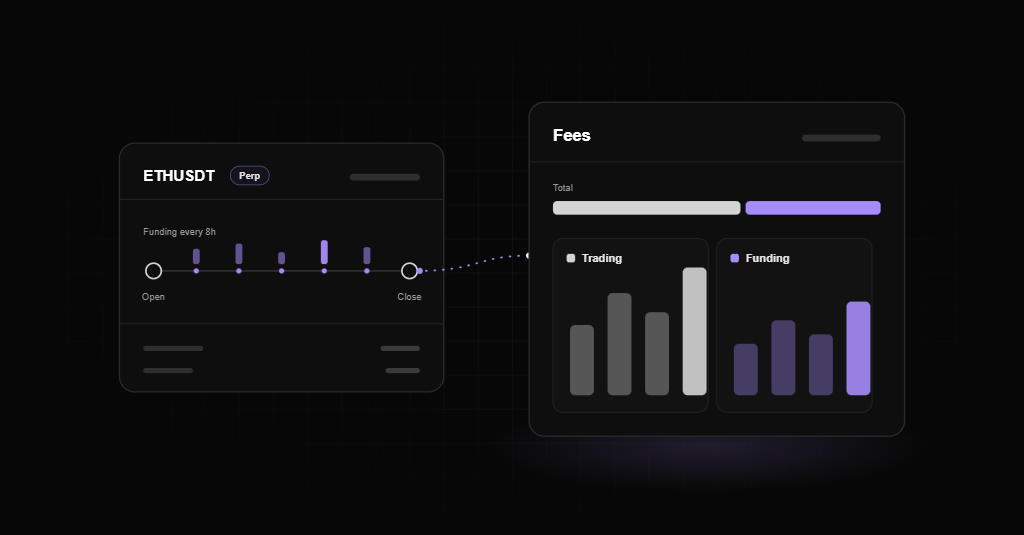
Trading fees cost you more when you trade often and hold briefly. Funding fees cost you more when you hold perps for days on the side that pays. The crossover is easy to work out: divide your round trip fee rate by the funding rate per interval, and that's how many funding payments it takes before funding passes your trading fees on a trade.
The answer is different for every trader, so treat any blanket claim with suspicion. Your own fee tier, the funding rates on the pairs you trade, and your typical hold time decide it.
What trading fees are
A trading fee is what the exchange charges each time an order fills. You pay it when you open and again when you close, so every trade pays at least twice. Scale in with three orders and out with two, and you've paid five times.
The fee is a percentage of the fill's notional value. Margin doesn't enter into it. A $1,000 margin position at 10x has a notional of $10,000, and the fee is charged on the $10,000.
Two things set the rate:
- Maker or taker. Orders that rest on the book and get filled later are usually charged a lower maker rate. Orders that fill right away against the book pay the taker rate.
- Your fee tier. Most exchanges lower rates as your 30 day volume grows, and some cut them further if you hold the exchange's token.
Trading fees never flip in your favor for most retail accounts. They're a cost on every fill, win or lose.
What funding fees are
Funding is a payment between traders holding perpetual futures. It exists to pull the perp price toward the spot price. When the perp trades above spot, longs pay shorts. When it trades below, shorts pay longs.
Funding is charged at set times. Some venues settle every hour and others every few hours. If you hold a position at a funding time, you pay or receive:
funding payment = position notional × funding rate for that interval
Three details trip people up:
- You only pay if you're holding at the funding time. Close a minute before, and you pay nothing for that interval.
- The rate changes every interval. It can be tiny for weeks, then jump when the market gets crowded on one side.
- Funding can be income. If you're on the receiving side, it adds to your result instead of taking from it.
Why they behave so differently
Trading fees are a cost of activity. They grow with the number of trades and the size you trade, and holding time doesn't change them at all.
Funding is a cost of time. It grows with how long you hold and how big the position is, and the number of trades doesn't change it.
So two traders with the same account and the same win rate can have opposite cost problems. One scalps 30 times a day and pays almost nothing in funding while fees eat a large part of the gross. The other holds three positions for a week and pays fees once per trade, while funding piles up in the background.
A worked example: when funding passes trading fees
This example uses made-up assumptions to show the math. These aren't market statistics, and real rates change constantly.
Assumptions:
- Position notional: $10,000 long on a BTC perp
- Taker fee: 0.05% per fill, so a round trip (open and close) costs 0.10%, or $10
- Funding rate: 0.01% per interval, with a funding time every 8 hours (three a day)
- Funding payment per interval: $10,000 × 0.01% = $1
- The long side pays funding for the whole hold, and notional stays at $10,000
| Hold time | Funding times crossed | Trading fees | Funding paid | Larger cost |
|---|---|---|---|---|
| 30 minutes | 0 | $10 | $0 | Trading fees |
| 12 hours | 1 or 2 | $10 | $1 to $2 | Trading fees |
| 2 days | 6 | $10 | $6 | Trading fees |
| 3 days 8 hours | 10 | $10 | $10 | Even |
| 7 days | 21 | $10 | $21 | Funding |
Under these assumptions, funding catches up with trading fees after 10 funding payments. The general version is:
break even funding payments = round trip fee rate ÷ funding rate per interval
0.10% ÷ 0.01% = 10 intervals. At three intervals a day, that's about 3 days and 8 hours.
Change one assumption and the answer moves a lot:
- If funding runs at 0.03% per interval during a crowded market, the break even drops to about 3.3 intervals. That's a little over a day.
- If you enter and exit with maker orders at 0.02% each, the round trip is 0.04%. At 0.01% funding, the break even is 4 intervals, or about 32 hours.
- If you're on the receiving side, funding lowers your cost, and trading fees are the only drag.
Now look at activity. Under the same assumptions, a trader who makes 20 round trips a day at $10,000 notional pays $200 a day in trading fees. To pay that much in funding, a single $10,000 position would need 200 funding payments, which is more than two months of holding. For an active intraday trader, trading fees are almost always the bigger number.
How to find which one costs you more
You don't need a market study. You need your own numbers, split in two.
- Pull a month of trades and add up trading fees.
- Pull the funding history for the same month from the exchange and add it up, counting payments you received as negative.
- Compare both totals with your gross PnL before costs.
- Split the trades by hold time: under an hour, same day, overnight, multi day.
Often one cost is clearly bigger. A trader who scalps will usually find fees. One who holds perps for days through crowded markets may find funding.
Then look at what drives the bigger number:
- If trading fees win, look at how often you pay the taker rate, how many times you scale in and out, and how many trades you take that you'd skip on a calmer day.
- If funding wins, look at which pairs charge you most, how long your average hold is, and whether those long holds were part of the plan or trades that drifted.
None of this tells you which side of the market to trade. It tells you where your money goes so you can decide on purpose.
For how to attach funding to individual trades and grade results after costs, read our guide to crypto futures journaling. To see both costs on one trade from first fill to net PnL, read the perpetual futures journal walkthrough.
How Hyerlo splits trading fees and funding
In Hyerlo, fees are tracked as two separate numbers from the start.
On the dashboard, the Fees card shows your total fees for the selected period, split between trading and funding. There's also a Fees chart that shows total fees with daily fees over time, so you can spot a week where costs jumped. Both follow the date range and the accounts you have selected.
When you add a trade by hand, the form has a Transaction Fee field and a Funding Fee field, so the split is there from the first trade. Manual entry is free on the Base plan.
On paid plans, Binance Futures syncs through a read-only API key, and Bybit, Phemex, Hyperliquid, and Binance USD-M can be brought in by CSV import. CSV import rebuilds closed trades from your fills and skips funding rows, so keep the exchange's funding history next to those trades when you review costs.
To tie costs back to holding time, the analytics page has a PnL by hold time view with buckets from under an hour to three days and longer. If your multi day bucket looks weak while the chart work was fine, funding is a good first place to look. The Duration widget on the dashboard shows how long you usually hold.
Base is free forever with manual entry. Breakout ($15 a month, $11 at launch pricing) adds three autosync accounts and CSV import, and new accounts get a 7 day trial of every feature with no card. Start at hyerlo.com.
Frequently asked questions
What is the difference between funding fees and trading fees?
Trading fees are charged by the exchange every time an order fills, as a percentage of notional. Funding fees are payments between longs and shorts on perpetual futures, charged at set intervals while you hold. Trading fees depend on how much you trade. Funding depends on how long you hold.
Which costs more, funding or trading fees?
It depends on your hold time, fee tier, and the funding rate. Divide your round trip fee rate by the funding rate per interval to find how many funding payments it takes for funding to catch up. Short holds and frequent trading usually make trading fees bigger. Multi day holds on the paying side can make funding bigger.
Can funding fees be positive?
Yes. When you're on the side that receives funding, the payment is added to your account. Over a long hold that income can cover your trading fees, although the rate can flip at the next interval.
Do I pay funding if I close before the funding time?
No. Funding is charged only on positions open at the funding time. A trade opened and closed between two funding times pays trading fees only.
How do I track funding fees in a trading journal?
Record funding separately from trading fees on each trade, or keep a funding log from your exchange's funding history and total it each week. Hyerlo's manual trade form has its own Funding Fee field, and the dashboard Fees card splits your totals between trading and funding.