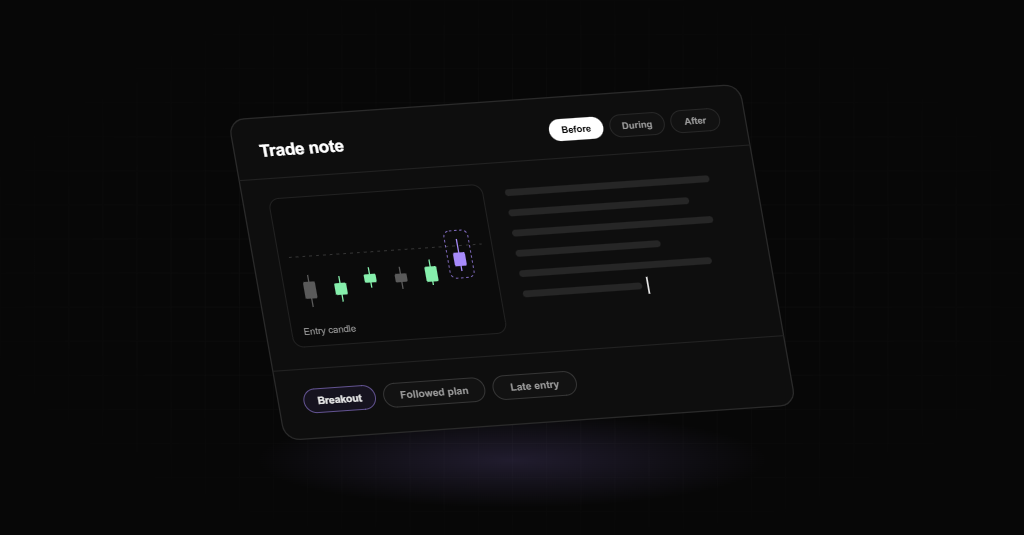
A good trading journal note records three moments. Before the trade, write the setup, the candle and context you're entering on, where you're wrong, and your size. During the trade, write down any change you make and why. After it closes, write whether you followed the plan, what you'd repeat, and one thing to change.
Short beats long. Four honest lines written right away are worth more than a page written from memory on Sunday.
Why notes and numbers need each other
Your fills, fees, and PnL tell you what happened. They can't tell you why you took the trade, what you saw on the chart, or what you were feeling when you moved your stop. That part only exists if you write it down.
Numbers without notes leave you guessing during review. Notes without numbers turn into a diary. Together they let you ask useful questions, like whether the trades you were confident about actually did better than the ones you weren't.
If you're still setting up your journal, our guide on how to journal crypto trades covers the routine, and the trading journal fields guide covers which columns to keep. This page is about the written part.
Before the trade: the plan note
Write this before you click buy or sell. If you can't fill it in, that's a sign the trade isn't ready.
- Setup. The name of the pattern you trade, written the same way every time.
- Thesis. One sentence on why price should move your way.
- The entry candle and context. What the chart looked like at the moment you entered.
- Invalidation. The price or event that proves you wrong, which is usually your stop.
- Target. Where you plan to take profit, or how you'll trail.
- Size and risk. Position size, the dollar amount you're risking, and leverage if it's a perp.
- State of mind. One word is enough: calm, rushed, bored, frustrated.
How to describe the candle you entered on
This line pays off in review more than any other. Write what the entry candle did and where it sat, in plain words:
- The candle's timeframe and shape: a 15 minute candle that closed near its high, a long wick rejecting a level, an inside bar
- Where it formed: at the prior day's high, at a range low, after a sweep of a recent low
- What came just before it: a sharp drop, a slow grind, three small candles going nowhere
- Volume, if you watch it: above or below what came before
Later you can search for every trade entered on, say, "close back above range low after sweep" and see whether that exact picture pays. "Entered long at 61,200" can't tell you that.
Example plan note (written for illustration, not a real trade):
Setup: range low reclaim. BTC swept the Asia low, then a 15m candle closed back inside the range near its high, with a long lower wick. Volume picked up on the reclaim candle. Long at the close. Wrong if a 15m candle closes back below the sweep low. Target is range mid, then trail. Risking $50 at 5x. Feeling calm, waited for the close this time.
During the trade: change notes
Most trades need no notes while they're open. Write only when you do something that wasn't in the plan, or when you're tempted to.
- Moved your stop, and in which direction
- Added to the position or took a partial
- Closed early or held past the target
- Felt a strong urge to act and didn't
Keep each one to a line with the time. These short notes catch the moment the plan and the behavior split apart, which is hard to remember later.
Example change notes (written for illustration):
10:42. Moved stop to breakeven after one green candle. Not in the plan. Felt nervous after yesterday's loss.
11:15. Took half off at range mid as planned. Trailing the rest under each 15m low.
After the trade: the review note
Write this the same day, ideally within a few minutes of closing. Memory starts rewriting the story fast, especially after a loss.
- Result in R or dollars, after fees
- Did you follow the plan? Yes, partly, or no, and where you stopped following it
- What went well that you'd repeat
- The mistake, if there was one, in a few words you can reuse as a tag
- One change for next time
Example review note (written for illustration):
Small win, about +0.6R after fees. Followed the entry and target. Broke the plan by moving the stop to breakeven early, which got me out of half before the move. Repeat: waiting for the candle close. Change: no stop moves until price reaches range mid.
Notice what isn't in there: a long story about the market or a verdict on yourself. A note is for the next review.
What goes in a tag and what goes in a note
Tags and notes do different jobs. Tags are for grouping and filtering, so they should be short and repeated exactly. Notes hold the detail a tag can't.
| Put it in a tag | Put it in a note |
|---|---|
| Setup name, like "range reclaim" | Why this one looked good today |
| Mistake type, like "moved stop" | What you were thinking when you moved it |
| Leverage, like "5x" | Liquidation distance and margin mode |
| Session, like "Asia" or "weekend" | The candle and context at entry |
| State, like "tilted" | What set it off |
Leverage belongs in a tag or note because exchanges generally don't include per-trade leverage in their trade history exports. If you don't write it down, it's gone.
Keep a short tag list and reuse it. "Moved stop," "moved-stop," and "stop moved" will split the same mistake into three groups that never add up.
Common mistakes with journal notes
- Writing everything after the week ends. By then the losing trades all sound reasonable.
- Writing only after losses. Wins need notes too, or you can't tell a good process from luck.
- Notes too long to reread. If you won't read it in review, it doesn't help.
- Judging instead of describing. "I'm an idiot" teaches nothing. "Entered before the candle closed" does.
- A new setup name every time. Pick names and stick to them, or you can't compare.
How notes and tags work in Hyerlo
In Hyerlo, every trade has a place for tags and a note, and notes work on every plan, including the free Base plan.
On the Trades page, select a trade and open Tags or Notes in the Overview panel. Tags label the trade with a setup, a mistake, or a lesson. You can filter the trades table by any tag, and Analytics groups trades by the first tag on each one to show which setups pay. Manage the full tag list from Actions, then Tags.
A trade note sits right next to the chart of that trade. The Snapshot chart button saves the current chart as a picture on the note, so the entry candle you described is there when you come back to it.
Trade notes also show up on the Notes page with a link that opens the trade on its chart. That page holds your other notes too. It ships with three templates: Trade review, Pre-market plan, and Weekly review. The Pre-market plan template has prompts for market context, key levels, your setup, invalidation, and risk budget, which lines up with the plan note above. You can build your own template from sections, so the before, during, and after prompts on this page can become a template you fill in each time.
Each note can have a tag, the symbols it covers, and up to eight pictures. Search matches titles, note text, tags, and symbols, so a search for "sweep" or "BTC" pulls up every note that mentions them. Favorites stay pinned at the top.
Log trades by hand on Base, or sync Binance Futures with a read-only API key on a paid plan. New accounts get a 7 day trial of every feature with no card. Start at hyerlo.com.
Frequently asked questions
What should I write in a trading journal?
Before the trade, write your setup, the entry candle and context, invalidation, target, size, and state of mind. During the trade, note any change to the plan and why. After it closes, write the result, whether you followed the plan, and one change for next time.
How long should a trading journal note be?
A few lines for each stage is enough. Short notes written right away are easier to keep up and easier to reread. If a note takes more than a couple of minutes, cut it down.
Should I write notes on winning trades too?
Yes. Without notes on wins, you can't tell whether a winner came from following your plan or from luck. Some of the most useful notes are on wins where you broke a rule.
What's the difference between tags and notes in a trading journal?
Tags are short labels you reuse, like a setup name or mistake type, so you can filter and group trades. Notes hold the detail: the reasoning, the candle and context, and what you were feeling. Use both.
Where should I record leverage in a trading journal?
In a tag or note on each trade. Exchanges generally don't include per-trade leverage in trade history exports, so it won't come in with an import. A tag like "5x" lets you filter later and compare results by leverage.